
Code of Conduct
Discipline Matrix - Student Infractions and Consequences
The Discipline Matrix (provided by the Georgia Department of Education) is designed to provide administrators and teachers a guideline for implementing interventions and consequences for student behavior. The interventions and consequences are progressively more intense if student misbehavior continues.
Principals have the authority and discretion to impose interventions and consequences ranked higher on the Discipline Matrix than indicated for each behavior. In the case of disciplinary violations not covered by the matrix, the principal may impose corrective measures which he/she believes to be in the best interest of the student involved and the school.
Prohibited Behavior
Use vulgar or profane language or gestures.
Engage in rowdy or unruly behavior.
Cheat, plagiarize, or represent others work as his/her own.
Possess a weapon or use any potentially harmful object as a weapon.
Use or possess tobacco products, tobacco paraphernalia, or any simulated tobacco products of any form, or actions that mimic the use or possession of tobacco products. Refer to district tobacco policy GAN to include e-cigarettes, tobacco-related objects, alternative nicotine products, vapor products or low THC oil or any vaporizing device not intended for medical use.
Occupy any school building, gymnasium, school grounds, properties, or part(s) thereof with the intent to deprive others of its use, or when the effect thereof is to deprive others of such use.
Block the entrance or exit of any school building, property, corridor, or room thereof so as to deprive others of such use.
Set fire to or otherwise damage any school building or property.
Participate in any gambling activity.
Use or threaten to use mace, pepper spray, or a similar potentially harmful substance.
Prevent or attempt to prevent the convening or continued functioning of any school, class, activity, lawful meeting, or assembly on the school campus.
Prevent students from attending a class or school activity.
Block normal pedestrian or vehicular traffic on a school campus or adjacent grounds.
Continuously and/or intentionally make noise or act in any other manner so as to interfere with a teacher’s ability to conduct a class or the job performance of any school system employee.
Bully, harass, verbally assault, or threaten another person.
Verbally or electronically assault or otherwise engage in disrespectful conduct toward a school system employee.
In any other manner by the use of violence, force, noise, coercion, threat, intimidation, fear, passive resistance, or any other conduct, intentionally cause the disruption of any lawful mission, process or function of the school, or engage in any such conduct causing the disruption or obstruction of any such lawful mission, process, or function (e.g. false fire alarm, riot, blockade, alarmist graffiti, bomb threat, etc.).
Refuse to identify himself/herself upon request of any school system employee.
Engage in inappropriate bodily contact to include kissing, displays of affection, or inappropriate sexual behavior.
Expose private body parts.
Engage in the unauthorized selling of items or solicitation for monies.
Be truant or chronically tardy.
Possess or use a laser pointer or reflective device.
Use an electronic device or cell phone during regular school hours unless authorized by an instructor or administrator. Cell phones and other electronic devices removed by school personnel are subject to search by the administration.
Commit a traffic violation on school grounds (e.g., speeding, reckless driving, illegal parking, etc.).
Commit or attempt to commit extortion.
Cause or attempt to cause willful or malicious damage and/or steal or attempt to steal real or personal property of the school or personal property of any person legitimately at school, during a school function, or an event off school grounds. Marking, defacing, or destroying school property or property of another student is included in this violation. Parents and/or students are responsible for restitution of damages or stolen property. PCSD is not responsible for lost, damaged, or stolen property.
Commit an act of physical violence, assault, fight, bodily injury, or threat to any person.
Disregard any reasonable directions or commands of any authorized school personnel.
Participate in hazing.
Possess bullets, ammunition, or fireworks.
Possess or be under the influence of alcoholic beverages, inhalants, drugs, or actions that mimic the use or possession of alcoholic beverages, inhalants, or drugs identified by the Georgia Controlled Substances Act.
Participate or have involvement in a gang.
Possess unauthorized prescription or nonprescription drugs.
Disciplinary Actions
When it is necessary to impose discipline, school administrators and teachers will follow a progressive discipline process by referencing the Discipline Matrix. The degree of discipline to be imposed by each school official will take into account the severity of the misbehavior of a particular student, the student’s discipline history, the age of the student, and other relevant factors. Disciplinary consequences/actions may look different between K-4 students and 5-12 students. All due process procedures required by federal and state law will be followed.
The Student Code of Conduct provides a systematic process of behavioral correction in which consequences follow inappropriate behaviors. Disciplinary actions are designed to teach students self-discipline and to help them substitute inappropriate behaviors with those that are consistent with character education programs.
The following disciplinary actions may be imposed for state-reportable and non-state reportable violations of the Student Code of Conduct:
Alternative School Placement
Behavior Contract
Confiscation of items not allowed at school
Corporal Punishment
Detention (in or after school)
Expulsion/Permanent Expulsion
Financial Restitution (for repair of any damage to school-related, private, or personal property)
In-School Suspension
In-Team Suspension/Time-Out
Isolation or Time-Out
Loss of Driving Privileges/Permits
Loss of Privileges
Mandatory Parent Escorts
Notification of Parents
Out-of-School Suspension
Parent Conference
Referral to Attendance Officer, Attendance Support Team, Magistrate and/or Juvenile Court
Referral to Disciplinary Tribunal
Referral to Law Enforcement
Restriction from School Programs and Special Assemblies
Saturday School
School Community Service (clean/repair damage caused to the school-related environment)
Silent lunch
Suspension or Expulsion from the School Bus
Temporary Removal from Class or Activity (athletics or extra-curricular activity
Warning and/or Counseling (with a school administrator, counselor, and/or teacher)
The maximum disciplinary actions for an offense include long-term suspension or expulsion. A disciplinary tribunal or the Pickens BOE shall only impose permanent expulsion.
Parents or students may elect not to contest whether a student has violated the Student Code of Conduct or the prescribed disciplinary consequences. In such cases, an agreement may be negotiated which would include the parents or students waiving their right to respond to a hearing before a disciplinary tribunal.
Before a student is suspended for ten (10) days or less, the principal or designee will inform the student of the offense for which the student is charged and allow the student to explain his or her behavior. If the student is suspended, the student’s parents/guardians will be notified, if possible. School officials may involve law enforcement officials when evidence surrounding a situation necessitates their involvement or when there is a legal requirement that an incident be reported.
Discipline Matrix Levels
The Discipline Matrix is built upon a progressive discipline philosophy and designed to create the expectation that the degree of consequences imposed by each school will be in proportion to the severity of the behavior of the student, the previous discipline history of the student, and other relevant factors while ensuring that each student receives due process mandated by law. In accordance with HB268, students who reach a certain disciplinary threshold will be supported through the Chronic Disciplinary Process.
NOTE: A student may be referred to a Disciplinary Hearing for the accumulation of seven (7) or more Code of Conduct violations. This may result in long-term suspension or expulsion.
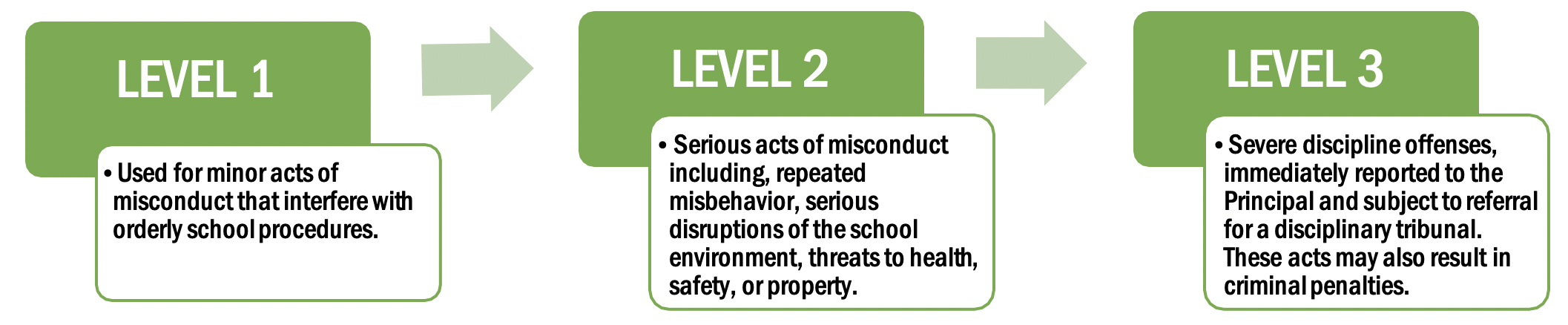
Level 1 (Mild) discipline is used for minor acts of misconduct which interfere with orderly school procedures, school functions, extracurricular programs, approved transportation, or a student’s own learning process. Students may be disciplined by the professional staff member involved or may be referred directly to the principal. These acts include, but are not limited to, repeated unrelated acts of minor misconduct and misbehaviors directed against persons or property, but which do not seriously endanger the health, safety, or well-being of others. Consideration of necessary behavior support services should be given, if not already provided.
Disciplinary Actions for Level 1 State Reportable Violations
Engaging in or attempting to commit any Level 1 offense can result in disciplinary action as outlined below.
1st Violation: Verbal Warning with administrative conference, or up to two days administrative detention, or In-School Suspension up to two (2) school days.
2nd Violation: Two days administrative detention, or In-School Suspension up to three (3) school days.
3rd Violation: In-school suspension up to five (5) school days.
4th Violation: Out-of-School Suspension of up to two (2) school days and Initiation of the chronic discipline process
5th Violation: Out-of-School Suspension up to three (3) school days.
6th Violation: Out-of-School Suspension up to five (5) school days.
7th Violation: The student will be suspended (In-School or Out-of-School) and the matter may be submitted to a Disciplinary Hearing Officer (See Level 3 Offenses).
*Subsequent Violations will repeat 3 days OSS.
Level 2 (Moderate) discipline offenses are serious acts of misconduct including, but not limited to, repeated misbehavior that is similar in nature, serious disruptions of the school environment, threats to health, safety, or property, and other acts of serious misconduct. These offenses must be reported to the principal. Offenses that threaten the health, safety or well-being of others may result in immediate suspension of the student from the school and/or school-sponsored activities for up to five school days, pending disciplinary investigation of the allegations. Student and parent/guardian participation in a conference with the principal/designee is a required element of all disciplinary actions in this category, even if such a conference has previously occurred. Initiation of necessary behavior support services should be given, if not already provided. Note that intentional possession and/or distribution of vapes or electronic smoking devices is automatically a Level 2 offense.
Disciplinary Actions for Level 2 State Reportable Violations
If necessary, restitution for damage to property, theft of property, or harm to any property by any means will be required. If necessary, law enforcement will be notified.
1st violation during the school year: Engaging in or attempting to commit any Level 2 offense during a school year can result in the student being assigned up to 5 consecutive school days of In-School Suspension or Short-Term Suspension. If the student commits any Level 1 violation while serving In-School Suspension, then the student will serve the remainder of the suspension out of school.
2nd violation during school year: Engaging in or attempting to commit any Level 2 offense for the second time during a school year can result in the student being assigned up to 10 consecutive school days of In-School Suspension or Short-Term Suspension. Depending on the circumstances surrounding the Level 2 violation, school administrators shall have the discretion to deviate from the progressive discipline policy. If the Level 2 violation warrants deviation from the progressive discipline policy, a student may be given other means instead of suspension, up to 10 consecutive days of In-School Suspension, assigned a Short-Term Suspension or be sent to a Disciplinary Hearing. If the Hearing Officer finds the student has engaged in or attempted to commit a second or subsequent Level 2 offense, the Hearing Officer may issue either a long-term suspension or expulsion from school. The student may be allowed to enroll at the alternative school provided the student complies with the enrollment rules.
3rd violation and any subsequent violation during the school year: Any student engaged in or attempting to commit a third or subsequent Level 2 offense during a school year may result in the student being assigned to Out-of-School Suspension with the matter being submitted to a Disciplinary Hearing Officer. If the Hearing Officer finds the student has engaged in or attempted to commit a third or subsequent Level 2 offense, the Hearing Officer may issue either a long-term suspension or expulsion from school. The student may be allowed to enroll at the alternative school provided the student complies with the enrollment rules.
Level 3 (Severe) discipline offenses represent the most serious acts of misconduct. These offenses must be immediately reported to the principal and are subject to referral for a disciplinary tribunal. These violations are so serious that they may require use of outside agencies and/or law enforcement. Such acts may also result in criminal penalties being imposed. Any misconduct that threatens the health, safety, or well-being of others may result in immediate suspension of the student from the school and/or school-sponsored activities for up to ten (10) school days, pending disciplinary investigation of the allegations. Student and parent/guardian participation in a conference with the principal/designee is a required element of all discipline actions in this particular category, even if such a conference has previously occurred. Initiation of necessary behavior support services should be given, if not already provided.
Disciplinary Actions for Level 3 Offenses
If necessary, restitution for damage to property, theft of property, or harm to any property by any means will be required. If necessary, law enforcement will be notified.
Engaging in or attempting to commit any Level 3 offense during a school year will result in the student being assigned Out-of-School Suspension with the matter being submitted to a Disciplinary Hearing Officer. If the Disciplinary Hearing Officer finds the student has engaged in or attempted to commit a Level 3 offense, the Hearing Officer may issue either a long-term suspension or expulsion from school. In accordance with 20-2-751.6, a student who is found by a disciplinary hearing officer, panel, or tribunal to have committed any act of physical violence against a teacher, school bus driver, or other school official or employee may be disciplined by expulsion, long-term suspension, or short-term suspension and shall be referred to juvenile court.
If the Hearing Officer finds that the student has engaged in or attempted to commit a second or subsequent Level 3 offense during a school year, the Hearing Officer will issue either a long-term suspension or expulsion from school.
State Reportable Disciplinary Matrix (Infractions and Consequence Levels) as defined by Georgia Department of Education
Disciplinary Infraction/State Code | Consequences (Level 1 = Mild, Level 2 = Moderate, Level 3 = Severe) |
|---|---|
Continuation of Incident (00) An event with multiple actions for a single incident has occurred. | |
Alcohol (01) Violation of laws or ordinances prohibiting the manufacture, sale, purchase, transportation, possession, beverages or substances represented as alcohol. Students under the or consumption of intoxicating alcoholic influence of alcohol may be included if it results in disciplinary action. | 1 – Unintentional possession of alcohol. 2 – Under the influence of alcohol without possession. 3 – Violation of laws or ordinances prohibiting the manufacture, sale, purchase, transportation,possession,or consumption of alcoholic beverages or substances represented as alcohol. |
Arson (02) Unlawful and intentional damage or attempted damage to any real or personal property by fire or incendiary devices. (Note: Possession of fireworks or incendiary devices must be reported as “Possession of Unapproved Items.” Use of such items should be reported as arson.) | 2 – Attempt to commit arson or use of matches, lighters, or incendiary devices at school; includes but not limited to the use of fireworks and/or trash can fires without damage to school property. 3 – Intentional damage as a result of arson-related activity or the use of an incendiary device; includes but not limited to setting fires to school property. |
Battery (03) Intentional touching or striking of another person to intentionally cause bodily harm. (Note: The key difference between battery and fighting is fighting involves mutual participation.) | 1 – Intentional physical attack with the intent to cause bodily harm resulting in no bodily injuries. Includes, but not limited to, pushing, hitting, kicking, shoving, pinching, slapping, and other intentional physical confrontations. 2 – Intentional physical attack with the intent to cause bodily harm resulting in mild or moderate bodily injuries. Includes, but not limited to, pushing, hitting, kicking, shoving, pinching, slapping, and other physical confrontations that result in mild or moderate injuries. 3 – Intentional physical attack with the intent to cause bodily harm resulting in severe injuries or any physical attack on school personnel. Physical attack on teachers should be reported as Violence Against a Teacher (44). Level 3 may be used for students who violate the school policy on battery three or more times during the same school year. Includes, but not limited to, choking, pushing, hitting, kicking, shoving, pinching, slapping, and other physical confrontations resulting in severe injuries. Includes any physical attack on school personnel and incidents serious enough to warrant calling the police or security. |
Breaking/Entering Burglary (04) Unlawful or unauthorized forceful entry into a school building or vehicle (with or without intent to commit theft). (Note: The key difference between Trespassing and Breaking & Entering-Burglary is that Trespassing does not include forceful entry into the school building.) | 3 – Unlawful or unauthorized forceful entry into a school building or vehicle (with or without intent to commit theft). |
Computer Trespass (05) Use of a school computer for anything other than instructional purposes or unauthorized use of a computer or computer network with the intention of deleting, obstructing, interrupting, altering, damaging, or in any way causing the malfunction of the computer, network, program(s) or data. | 2 – Unauthorized use of school computer for anything other than instructional purposes. Includes but not limited to computer misuse, using computer to view or send inappropriate material and violation of school computer use policy. 3 – Unauthorized use of a computer or computer network with the intention of deleting, obstructing, interrupting, altering, damaging, obtaining confidential information or in any way causing the malfunction of the computer, network, program(s) or data; includes disclosure of a number, code, password, or other means of access to school computers or the school system computer network without proper authorization. Includes but not limited to hacking. |
Disorderly Conduct (06) Any act that substantially disrupts the orderly conduct of a school function, substantially disrupts the orderly learning environment, or poses a threat to the health, safety, and/or welfare of students, staff, or others. (Includes disruptive behaviors on school buses.) | 1 – Creating or contributing to a moderate disturbance that substantially disrupts the normal operation of the school environment but doesn't pose a threat to the health or safety of others. Including but not limited to general bus misbehavior, spitting on property or persons, encouraging disruptive behavior. 2 – Creating or contributing to a severe disturbance that substantially disrupts the normal operation of the school environment but doesn't pose a threat to the health or safety of others; may represent a repeat action. Including but not limited to general bus misbehavior, spitting on property or persons, encouraging disruptive behavior. 3 – Creating or contributing to a severe disturbance that substantially disrupts the school environment or poses a threat to the health and safety of others. Level 3 may be used for students who violate the school policy on disorderly conduct three or more times during the same school year. Including but not limited to disruptive behavior on school bus, misbehavior during a fire drill or other safety exercises. |
Drugs, except Alcohol and Tobacco (07) Unlawful use, cultivation, manufacture, distribution, sale, purchase, possession, transportation, or importation of any controlled drug or narcotic substance, or equipment or devices used for preparing or using drugs or narcotics; or any medication prescribed to a student or purchased over-the-counter and not brought to the office upon arrival to school. | 1 – Unintentional possession of prescribed or over the counter medication. Does not include the possession of narcotics or any illegal drugs. Does not include auto-injectable epinephrine as properly administered pursuant to O.C.G.A. § 20-2-776. 2 – Any medication prescribed to a student or purchased over-the-counter and not brought to the office upon arrival to school. Does not include auto-injectable epinephrine as properly administered pursuant to O.C.G.A. § 20-2-776. 3 – Unlawful use, cultivation, manufacture, distribution, sale, purchase, possession, transportation, or importation of any controlled drug or narcotic substance, or equipment or devices used for preparing or using drugs or narcotics. Does not include auto-injectable epinephrine as properly administered pursuant to O.C.G.A. § 20-2-776. |
Fighting (08) Mutual participation in a fight involving physical violence where there is no one main offender and intent to harm. Note: The key difference between fighting and battery is that fighting involves mutual participation. | 1 – A physical confrontation between two or more students with the intent to harm resulting in no bodily injuries. 2 – A physical confrontation between two or more students with the intent to 3 – A physical confrontation between two or more students with the intent to harm resulting in severe bodily injuries. Level 3 may be used for students who violate the school policy on fighting three or more times during the same school year. Repeated physical confrontations resulting in severe injuries that require medical attention. |
Homicide (09) Killing of one human being by another. | 3 – Killing of a human being. Includes but is not limited to shooting, stabbing, choking, bludgeoning, etc. |
Kidnapping (10) The unlawful and forceful abduction, transportation, and/or detention of a person against his/her will. | 3 – Unlawful and forceful abduction, transportation, and/or detention of a person against his/her will. |
Larceny/Theft (11) The unlawful taking of property belonging to another person or entity (e.g., school) without threat, violence or bodily harm. (Note: The key difference between larceny/theft and robbery is that the threat of physical harm or actual physical harm is involved in a robbery.) | 1 - The unlawful taking of property belonging to another person or entity that does not belong to the student with a value between $25 and $100. Includes but not limited to theft by taking, theft by receiving stolen property, and theft by deception. 2 - The unlawful taking of property belonging to another person or entity that does not belong to the student with a value between $100 and $250. Includes but not limited to theft by taking, theft by receiving stolen property, and theft by deception. 3 - The unlawful taking of property belonging to another person or entity that does not belong to the student with a value exceeding $250. Level 3 may be used for students that violate the school policy on larceny/theft three or more times during the same school year. Includes but not limited to theft by taking, theft by receiving stolen property, and theft by deception. |
Motor Vehicle Theft (12) Theft or attempted theft of any motor vehicle. | 3 – Theft or attempted theft of any motor vehicle. Includes but not limited to cars, trucks, ATVs, golf carts, etc. |
Robbery (13) The taking of, or attempting to take, anything of value that is owned by another person or organization under confrontational circumstances by force or threat of force or violence and/or by putting the victim in fear. (Note: The key difference between robbery and larceny/theft is that the threat of physical harm or actual physical harm is involved in a robbery.) | 2 - Robbery without the use of a weapon. Taking something by force or threat of force. 3 - Robbery with the use of a weapon. Weapons may include but are not limited to guns, knives, clubs, razor blades, etc. |
Sexual Battery (14) Oral, anal, or vaginal penetration against the person's will or where the victim did not or is incapable of giving consent; touching of private body parts of another person either through human contact or using an object forcibly or against the person's will or where the victim did not or is incapable of giving consent. | 3 - Oral, anal, or vaginal penetration against the person's will or where the victim did not or is incapable of giving consent; touching of private body parts of another person either through human contact or using an object forcibly or against the person's will or where the victim did not or is incapable of giving consent. Includes but is not limited to rape, fondling, child molestation, indecent liberties and sodomy. |
Sexual Harassment (15) Non-physical and unwelcome sexual advances, lewd gestures or verbal conduct or communication of a sexual nature; requests for sexual favors; gender-based harassment that creates an intimidating, hostile, or offensive educational or work environment. | 1 - Comments that perpetuate gender stereotypes or suggestive jokes that are not directed towards specific individuals. Includes but not limited to insensitive or sexually suggestive comments or jokes. 2 - Comments that perpetuate gender stereotypes, suggestive jokes or lewd gestures that are directed towards specific individuals or group of individuals. Includes, but not limited to insensitive or sexually suggestive comments or jokes; leering. 3 - Physical or non-physical sexual advances; requests for sexual favors; Level 3 may be used for students that violate the school policy on sexual harassment three or more times during the same school year. |
Sexual Offense (16) Unlawful sexual behavior, sexual contact without force or threat of force, or possession of sexually explicit images; can be consensual. | 1 – Inappropriate sexually based physical contact including but not limited to public groping, inappropriate bodily contact, or any other sexual contact not covered in levels 2 or 3. Examples include but not limited to public groping or inappropriate bodily contact. 2 – Inappropriate sexually-based behavior including but not limited to sexting, lewd behavior, possession of pornographic materials; simulated sex acts. Examples include but not limited to sexting; lewd behavior, possession of pornographic materials; simulated sex acts. 3 – Engaging in sexual activities on school grounds or during school activities. Examples include but not limited to sexual misconduct; prostitution; indecent exposure of private body parts. |
Threat/Intimidation (17) Any threat through written or verbal language or act which creates a fear of harm and/or conveys a serious expression of intent to harm or violence without displaying a weapon and without subjecting the victim to actual physical attack. | 2 – Physical, verbal or electronic threat which creates fear of harm without displaying a weapon or subjecting victims to physical attack. Examples include but not limited to physical, verbal or electronic threats. 3 – School-wide physical, verbal or electronic threat which creates fear of harm without displaying a weapon or subjecting victims to physical attack. Note: Students that display a pattern of behavior that is so severe, persistent, or pervasive so as to have the effect of substantially interfering with a student’s education, threatening the educational environment, or causing substantial physical harm, threat of harm or visible bodily harm may be coded as bullying. Includes but not limited to bomb threats or unauthorized pulling of the fire alarm. |
Tobacco (18) Possession, use, distribution, or sale of tobacco products on school grounds, at school-sponsored events, and on transportation to and from school. Does not include electronic smoking devices; See Electronic Smoking Devices (42). | 1 – Unintentional possession of tobacco products on school property. 2 – Use of or knowledgeable possession of tobacco products on school property. 3 – Distribution and/or selling of tobacco products; Level 3 may be used for students that violate the school policy on tobacco three or more times during the same school year. |
Trespassing (19) Entering or remaining on a public-school campus or school board facility without authorization or invitation and with no lawful purpose for entry. (Note: Trespassing does not include forceful entry into the school building). | 2 – Entering or remaining on school grounds or facilities without authorization and with no lawful purpose. 3 – Entering or remaining on school grounds or facilities without authorization and with no lawful purpose. Refusing to leave school grounds after a request from school personnel; Level 3 may be used for students who violate the school policy on trespassing three or more times during the same school year. |
Vandalism (20) The willful and/or malicious destruction, damage, or defacement of public or private property without consent. | 2 – Participating in the minor destruction, damage or defacement of school property or private property without permission. 3 – Participation in the willful/malicious destruction, damage or defacement of school property or private property without permission; Level 3 may be used for students that violate the school policy on vandalism three or more times during the same school year. |
Weapons/Knife (22) The possession, use, or intention to use any type of knife. | 1 – Unintentional possession of a knife or knife-like item without intent to harm or intimidate. 2 – Intentional possession of a knife or knife-like item without intent to harm or intimidate. 3 – Intentional possession, use or intention to use a knife or knife-like item with the intent to harm or intimidate. |
Weapons/Other (23) The possession, use, or intention to use any instrument or object that is used or intended to be used in a manner that may inflict bodily harm (does not include knives or firearms). | 2 – Unintentional possession of a weapon, other than a knife or firearm, or simile of a weapon that could produce bodily harm or fear of harm. Includes but is not limited to razor blades, straight edge razors, brass knuckles, blackjacks, bats, clubs, nun chucks, throwing stars, stun guns, tasers, etc. 3 – Intentional possession and/or use of any weapon, other than a knife or firearm, in a manner that could produce bodily harm or fear of harm. Includes, but is not limited to razor blades, straight-edge razors, brass knuckles, blackjacks, clubs, nun chucks, throwing stars, stun guns, tasers, etc. |
Other Incident for a State-Reported Discipline Action (24) Any other discipline incident for which a student is administered corporal punishment, detention, in-school or out-of-school suspension, expelled, suspended for riding the bus, assigned to an alternative school, referred to court or juvenile system authorities, or removed from class at the teacher's request (pursuant to O.C.G.A. 20-2738) . | 1 - Any other discipline incident for which a student is administered corporal punishment, detention, in-school or outof-school suspension, expelled, suspended for riding the bus, assigned to an alternative school, referred to court or juvenile system authorities, or removed from class at the teacher's request (pursuant to O.C.G.A. 20-2-738). 2 - Level 2 should be used for students who display a pattern of violating local school policies not listed among the state incident types. Includes but is not limited to parking violations, etc. |
Weapons - Handgun (25) Possession of a firearm that has a short stock and is designed to be held and fired by the use of a single hand; and any combination of parts from which a firearm described above can be assembled. NOTE: This definition does not apply to items such as toy guns, cap guns, bb guns and pellet gun [Pursuant to Gun-Free Schools Act - Public Law 107-110, Section 4141]. | 3 - Intentional or unintentional possession or use of a handgun in a manner that could produce bodily harm or fear of harm. |
Weapons – Rifle/Shotgun (26) The term “rifle” means a weapon designed or redesigned, made or remade, and intended to be fired from the shoulder and designed or redesigned and made or remade to use the energy of an explosive to fire only a single projectile through a rifled bore for each single pull of the trigger. The term “shotgun” means a weapon designed or redesigned, made or remade, and intended to be fired from the shoulder and designed or redesigned and made or remade to use the energy of an explosive to fire through a smooth bore either a number of ball shot or single projectile for each single pull of the trigger. (Pursuant to Gun-Free Schools Act – Public Law 107-110, Section 4141) | 3 – Intentional or unintentional possession or use of a rifle or shotgun in a manner that could produce bodily harm or fear of harm. |
Serious Bodily Injury (27) The term “serious bodily injury” means bodily injury that involves a substantial risk of death, protracted and obvious disfigurement; or protracted loss or impairment of the function of a bodily member, organ, or mental faculty. | 3 - Infliction of "bodily harm" that dismembers, disfigures, causes permanent loss of a limb or function of an organ and causes substantial risk of death. Any behavior that dismembers, disfigures, causes permanent loss of a limb or function of an organ and causes substantial risk of death. |
Other Firearms (28) Firearms other than handguns, rifles, or shotguns as defined in 18 USC 921. Includes any weapon (including starter gun) which will or is designed to or may readily be converted to expel a projectile by the action of any explosive; the frame or receiver of any weapon described above; any firearm muffler or firearm silencer; any destructive device, which includes any explosive, incendiary, or poison gas (i.e., bomb, grenade, rocket having a propellent charge more than 4 ounces, missile having an explosive or incendiary charge of more than ¼ ounce, mine, or similar device); any weapon which will, or which may be readily converted to, expel a projectile by the action of an explosive or other propellant, and which has any barrel with a bore of more than ½ inch in diameter; any combination or parts either designed or intended for use in converting any device into any destructive device described above, and from which a destructive device may be readily assembled. (Note: This does not include toy guns, cap guns, bb guns, pellet guns, or Class-C common fireworks). (Pursuant to Gun- Free Schools Act – Public Law 107-110, Section 4141). | 3 – Intentional or unintentional possession or use of any firearms other than rifle, shotgun, or handguns (including starter pistols) and any other destructive device which includes explosives. Includes any weapon (including starter gun) which will or is designed to or may readily be converted to expel a projectile by the action of any explosive; the frame or receiver of any weapon described above; any firearm muffler or firearm silencer; any destructive device, which includes any explosive, incendiary, or poison gas (i.e. bomb, grenade, rocket having a propellant charge more than 4 ounces, missile having an explosive or incendiary charge of more than ¼ ounce, mine, or similar device); any weapon which will, or which may be readily converted to, expel a projectile by the action of an explosive or other propellant, and which has any barrel with a bore of more than ½ inch in diameter; any combination or parts either designed or intended for use in converting any device into any destructive device described above, and from which a destructive device may be readily assembled. (Note: This does not include toy guns, cap guns, bb guns, pellet guns, or Class-C common fireworks). [Pursuant to Gun-Free Schools Act – Public Law 107-110, Section 4141] |
Bullying (29) Behavior, which may include written, verbal, physical acts, or through a computer, computer system, computer network, or other electronic technology occurring on school property, on school vehicles, at designated school bus stops, or at school related functions that is so severe, persistent, or pervasive so as to have the effect of substantially interfering with a student’s education, threatening the educational environment, or causing substantial physical harm or visibly bodily harm. | 1 - First Offense of bullying as defined in Georgia Code Section 20-2-751.4. Includes but is not limited to unwanted teasing, threats, name-calling, intimidation, harassment, humiliation, hazing, physical attacks, extortion, social exclusion, coercion, spreading of rumors or falsehoods, gossip, stalking, or using any type of electronic means to harass or intimidate. 2 - Second incident of bullying as defined in Georgia Code Section 20-2-751.4. Includes but is not limited to unwanted teasing, threats, name-calling, intimidation, harassment, humiliation, hazing, physical attacks, extortion, social exclusion, coercion, spreading of rumors or falsehoods, gossip, stalking, or the use of electronic equipment on school property or using school equipment to harass or intimidate. 3 - Repeated acts, as defined in Georgia Code Section 20-2-751.4, occurring on school property or school possession that is a willful attempt or threat to inflict injury, or apparent means to do so, any display of force that puts victim at fear of harm, any written, verbal or physical act that threatens, harasses, or intimidates; causes another person physical harm; interferes with a student's education; so severe and pervasive intimidated or threatens educational environment. Includes but is not limited to unwanted teasing, threats, name-calling, intimidation, harassment, humiliation, hazing, physical attacks, extortion, social exclusion, coercion, spreading of rumors or falsehoods, gossip, stalking, or the use of electronic equipment on school property or using school equipment to harass or intimidate. |
Other - Attendance Related (30) Repeated or excessive unexcused absences or tardiness; including failure to report to class, skipping class, leaving school without authorization, or failure to comply with disciplinary sanctions. | 1 - Repeated or excessive unexcused absences or tardiness; including failure to report to class, skipping class, leaving school without authorization, or failure to comply with disciplinary sanctions. Repeated or excessive unexcused absences or tardiness; including failure to report to class, skipping class, leaving school without authorization, or failure to comply with disciplinary sanctions. |
Other - Dress Code Violation (31) Violation of school dress code that includes standards for appropriate school attire. | 1 - Non-invasive and non-suggestive clothing, jewelry, book bags or other articles of personal appearance. Pursuant to local dress codes, dress code violations for Level 1 may Include but are not limited to bare feet; trousers, slacks, shorts worn below waist level; no belt; clothing that is excessively baggy or tight; skirts or shorts that are shorter than mid-thigh; sunglasses worn inside the building; hats, caps, hoods, sweatbands and bandanas or other head wear worn inside school building. 2 - Invasive or suggestive clothing, jewelry, book bags or other articles of personal appearance. Pursuant to local dress codes, dress code violations for Level 2 may include but are not limited to depiction of profanity, vulgarity, obscenity or violence; promote the use or abuse of tobacco, alcohol or drugs; creates a threat to the health and safety of other students; creates a significant risk of disruption to the school environment; clothing worn in such a manner so as to reveal underwear, cleavage or bare skin; spaghetti straps, strapless tops, halter tops, see-through or mesh garments or other clothing that is physically revealing, provocative or contains sexually suggestive comments. 3 - Invasive or suggestive clothing, jewelry, book bags or other articles of personal appearance. Level 3 may be used for students that violate the school dress code policy three or more times during the same school year. Level 3 may be used for students that violate the school dress code policy three or more times during the same school year. |
Academic Dishonesty (32) Receiving or providing unauthorized assistance on classroom projects, assignments or exams. | 1 - Intentional receiving or providing of unauthorized assistance on classroom projects, assessments and assignments. May include but is not limited to failure to cite sources. 2 - Intentional plagiarism or cheating on a minor classroom assignment or project. Includes but is not limited to Intentional dishonesty on minor classroom projects, assignments, homework, etc. 3 - Intentional plagiarism or cheating on a major exam, statewide assessment or project or the falsification of school records (including forgery). Includes but is not limited to cheating on major exams, statewide assessments or other state mandated academic work; Includes the falsification of school records; forgery; Level 3 may be used for students that violate the school policy on academic dishonesty three or more times during the same school year. |
Other - Student Incivility (33) Insubordination or disrespect to staff members or other students; includes but is not limited to refusal to follow school staff member instructions, use of vulgar or inappropriate language, and misrepresentation of the truth. | 1 - Failure to comply with instructions or the inadvertent use of inappropriate language. May include but is not limited to general disrespect for school staff or students; profanity; failure to follow instructions. 2 - Blatant insubordination or the use of inappropriate language directed towards school staff or peers; intentional misrepresentation of the truth. Profanity or obscene language directed towards school staff; issuing false reports on other students; insubordination. 3 - Blatant and repeated insubordination or intentional misrepresentation of the truth; Level 3 should be used for students who display a pattern of violating the school policy related to student incivility. Issuing false reports on school staff; Level 3 may be used for students that violate the school policy on student incivility three or more times during the same school year. |
Other - Possession of Unapproved Items (34) The use or possession of any unauthorized item disruptive to the school environment. Note: The use of fireworks or incendiary devices must be coded as (02) Arson. The unauthorized possession or use of cell phones or other personal electronic devices must be reported as (45) Personal Electronic Devices. | 1 - The possession of any unauthorized item. Does not include the possession of fireworks, matches, toy weapons, or other items that can be construed as dangerous. Includes but is not limited to possession of toys, gadgets, personal items, gum, candy, etc; includes possession of pepper spray. 2 - The use of any unauthorized item (i.e. toys, gadgets). Does not include the possession of fireworks, matches, toy weapons, or other items that can be construed as dangerous. Includes but is not limited to use of toys, gadgets, personal items, etc; includes the use of pepper spray without injury. 3 - The use or possession of unauthorized items including but not limited to toy guns or other items that can be construed as dangerous or harmful to the learning environment; Includes the possession of matches, lighters, incendiary devices or fireworks. The use of matches, lighters, incendiary devices or fireworks should be coded as Arson; Level 3 should be used for students who display a pattern of violating the school policy related to unapproved items. Includes but are not limited to matches, lighters, or the possession of fireworks, bullets, stink bombs, CO2 cartridges; includes the use of pepper spray with injury. |
Gang-Related (35) Any group of three or more students with a common name or common identifying signs, symbols, tattoos, graffiti, or attire which engage in criminal gang activity (O.C.G.A. § 1615-3). | 2 - Wearing or possessing gang-related apparel; communicating either verbally or non-verbally to convey membership or affiliation with a gang. Possession or wearing of gang-related clothing, jewelry, emblems, badges, symbols, signs, or using colors to convey gang membership or affiliation; gestures, handshakes, slogans, drawings, etc. to convey gang membership or affiliation; committing any other illegal act or other violation of school policies in connection with gang-related activity. 3 - The solicitation of others for gang membership, the defacing of school or personal property with gang-related symbols or slogans, threatening or intimidating on behalf of a gang, the requirement or payment for protection or insurance through a gang. Level 3 should be used for students who display a pattern of violating the school policy related to gang activity. Soliciting students for gang membership; tagging or defacing school or personal property with symbols or slogans intended to convey or promote membership or affiliation in any gang; requiring payment for protection, insurance, otherwise intimidating or threatening any person related to gang activity; inciting other students to intimidate or to act with physical violence upon any other person related to gang activity. |
Repeated Offenses (36) Collection of offenses not previously assigned a state reportable action that occurs on a single or across multiple school days that leads to a state reportable disciplinary action. | 1 - Collection of minor incidents. 2 - Collection of moderate incidents. 3 - Collection of severe incidents. |
Other Non-Disciplinary Incident (40) This code is used exclusively for the reporting of Physical Restraint. When the INCIDENT TYPE = ‘40’, then the ACTION CODE must = ‘95’ for Physical Restraint. Do not report a Teacher ID when Incident Code is “Other Non-Disciplinary Incident.” | Can only be used to report "Physical Restraint" with Action "95" (no teacher name). |
Electronic Smoking Device (42) Any device used to deliver nicotine or any other substance intended for human consumption that may be used by a person to simulate smoking through inhalation of vapor or aerosol from the device. Such devices include those manufactured, distributed, marketed or sold as an electronic cigarette, electronic cigar, electronic cigarillo, electronic pipe, electronic hookah, vape pen, electronic nicotine delivery system or any cartridge or other component of the device or related product. | 1 - Unintentional possession of an electronic smoking device. 2 - Use or knowledgeable possession of an electronic smoking device. 3 - Distribution and/or selling of electronic smoking devices: Level 3 may be used for students that violate school policy on electronic smoking devices three or more times during the same school year |
Violence Against a Teacher (44) Intentional physical attack against a teacher with the intent to cause bodily harm resulting in severe injuries or any physical attack against a teacher. Violence against other school personnel should be reported as Battery (03) – Level 3. | 3 - Intentional physical attack against a teacher with the intent to cause bodily harm resulting in severe injuries or any physical attack against a teacher. Violence against other school personnel should be reported as Battery (03) – Level 3. |
Personal Electronic Devices (45) Any portable electronic device capable of transmitting, receiving, or accessing communications, data, or media. The term personal electronic devices includes, but is not limited to, smart phones, smartwatches, tablets, headphones, and other devices with functionalities such as wireless communication, internet access, messaging, video recording, gaming, social media access, or data transmission. | 1 - An unauthorized use or possession of a personal electronic device that requires administrative action, involves minimal disruption to instruction or school operations, and the student complies when directed by administrator. 2 - An unauthorized use or possession of a personal electronic device that moderately disrupts instruction or school operations and requires escalated administrative action, but the student ultimately complies when directed. 3 - An unauthorized use or possession of a personal electronic device that results in refusal to comply, significant disruption to instruction or school operations, or other serious escalation requiring immediate administrative action. |